It’s Fun to Fail

Dearest Readers,

If you are in the Northern hemisphere, Happy Summer! Wherever you are, if you’re not feeling happy, I understand. It’s hard to be human even when the sun is shining.

I realized yesterday that today is the last day of June, which meant I had only one day to write this Letter since committing last fall to publishing once a month.

What to do?

Dash something trivial off? Stay up all night writing? Let myself off the hook?

I like the last option but it just so happens I have a wee story that won’t take me that long to share.

When I facilitate a workshop or retreat, I always include improv because it teaches listening, presence, and trust, and because laughter is good medicine.

One of the “rules” of improv is “it’s fun to fail.” This means, if you make a mistake: fun! If you mess up: fun! If everything falls apart: fun!

Last week, at a retreat I facilitated called “Sacred Silliness”, I told a knock-knock joke. It went like this:

“Knock-Knock,” I said.

“Who’s there?”, the group asked.

“God,” I said.

“God who?” they asked.

“I don’t have a last name,” I answered.

Crickets.

I think it’s a funny joke so I had been expecting a wave of laughter but there was total and complete silence. This joke bombed. Big time. I mean, like, it died a thousand deaths.

It was mortifying.

And …

In real time, I could model exactly what I was teaching that day. It’s fun to fail! There’s no shame in bombing. It’s no big deal to fail. In fact, it’s fun!

Admittedly, I had to work it. Feelings of embarrassment and discomfort were fighting for emotional victory. But the opportunity to have a sense of humour about tanking was unmistakable. I could embrace it.

So I did. Throughout the day, I repeatedly used my comic death moment as an example of “it’s fun to fail”. You know what? Doing that got the laughs the joke didn’t.

May our mistakes be opportunities to let go, laugh and have a little more fun. These days, we all need it.

Love and blessings,

Celia
This and That

Dearest Readers,

The sun is shining as I write this and the leaves on the trees have unfurled into their full size. I hope you are finding peace in the beauty of the natural world, wherever you are.

The other day, I had a brief conversation with a friend about “retreat”. I was saying how much silent and creative retreats benefit me (as often as life and finances allow), and she was saying how much she could use one.

Retreats are mostly for the privileged but they shouldn’t be. Everyone needs a break. Everyone deserves an opportunity to discover the luxury of being quiet, of listening to the inner voice, of resting and be-ing.

On my last retreat, I signed up for a 30-minute spiritual direction session, having never met the director. I was early. He was late. When he arrived, cheerful and smiling, we sat down and immediately started chit-chatting. The session never really “started” as spiritual direction sessions sometimes do, with silence or a blessing, so I thought I’d better get down to deeper matters. The clock was ticking.

I shared about the general anxiety I feel about the state of the world and he listened without judgment. He shared some of his own history working with refugees and the hard problem of suffering. I asked him how he managed to hold it all. He paused, thought about it, and said, “The best I can say is that I am at peace and I am not at peace.”

I am at peace and I am not at peace. Wow.

For a black-and-white thinker, this paradoxical statement is salve for the soul. O, how I practice the grey, middle ground, two-truths-at-once kind of attitude. Still, I mostly want things to be this or that.

I’ve written about this before. Things can be this and that. Two things can be true at once. Radical, I know!

We can be at peace and not at peace at the same time. We can be faithful and doubting, trusting and angry, relaxed and anxious, this and that. And everything in between.

Permission to be a messed-up and got-it-together human? Permission granted.

And if you can make the time and find the means, go on retreat and meet your mysterial self there.

Love and blessings,

Celia

The Sloth

Dearest Readers,

Here in Southern Ontario, green things are pushing up out of the ground and myriad colours now supersede the greys and browns. Despite these dark times, Nature insists we celebrate life. I hope you are finding ways to feel wonder and awe amid the ongoing strife.

Another animal story for you:

Last summer, my beau and I visited Espace pour la Vie Montréal, which includes the Biodôme, a “museum of enclosed ecosystems”, one of which houses a Southern two-toed sloth.

The sloth is a big draw. There are images and ads all over the place encouraging a visit to the Tropical Rainforest ecosystem to see the paresseux à deux doigts (a sloth’s French name).

After being hypnotized by the tiny, human-like face of the Golden lion tamarin, a laminated sign directed us toward the location of the sloth. We looked and looked through the dripping trees and lush vegetation to no avail.

Then, we spotted it. The star of the show had climbed up beyond the fabricated jungle, up more than 50 feet above us, up to the concrete, glass and steel-arched roof, wedging itself into the furthest corner it could find.

My heart broke into a thousand and seventy-one pieces. This beloved creature was obviously trying to get away from our staring eyes, pointing fingers and incessantly clicking phones.

But was it?

I just now read on the Biodôme’s website that sloths “spend most of their time in the trees, rarely descending to the ground. They live very high in the forest canopy, at altitudes of up to 2100 m.”

For the last year, whenever I have thought of the sloth, I have felt a great sadness, thinking of it trying to get as far away from us as possible. But it turns out the sloth was just doing what sloths do, living “high” and “rarely descending to the ground.”

The truth is, I have no idea what the sloth feels. Maybe it is miserable. But maybe it’s quite content in its equatorial environment. Maybe it loves the feeling of the cool steel against its thick, wiry fur. Maybe it enjoys looking out through the massive skylight-ceiling at the clouds and the stars. What do I know?

I know that I felt sad. And I need to honour that.

May we all feel our sadness when it arises and take care of our tender hearts when they break.

With love and blessings,

Celia

Worth It

Dearest Readers,

I hope you are continuing to find ways to make meaning in these fraught times. There is so much goodness to balance out the madness, it just needs to be sought!

The other day, I was presented with an opportunity to reflect on the concept of “worth” when I attended a talk by Hannah Moscovitch, a super-successful Canadian playwright and a top writer for television.

Hannah was honest and forthright about the highs and lows of writing for TV and made light of the “crazy difference in pay scale” between theatre and television. She joked, “When you’re a playwright, you’re like, ‘Thank you for this forty-five dollars’, and after writing for television for a while you’re like, ‘Wow, I can buy a ski chalet.’” Her candour was refreshing.

Naturally, Hannah’s success made me envious. For most of my young life, I was told I was going to be famous and it’s been an ongoing process to contend with the fact that I’m not.

After Hannah gave her talk, the part of me that longed for starry success needed some attention. I told my little fame-seeker that it was okay to want what Hannah had. It was okay to want to be the darling of critics, to have famous actors saying my words on the New York stage, to be an in-demand show-runner in the entertainment biz. It was okay to want all of that.

But did I really want it? Would I trade any of those things for the life I have now? What kind of “worth” does my life have?

Two things came to me. The first was the response of a dying man when I sang to him as he slipped away. “Thank you,” he said, “Thank you, thank you.” I will never forget, for as long as I live, the broken tenderness in his voice as he repeated his gratitude.

The second was the phone call I received from the same man’s brother, letting me know he had died. The brother was a life-long trucker: tough exterior, soft heart. As he broke the news, his voice quavered. He was torn apart but stoically holding it together. He thanked me for being his brother’s friend. It had meant something to them both.

How do we measure worth? I can’t buy a ski chalet but these two experiences make me feel like I’ve hit the jackpot.

May you discover and uncover what has worth in your life.

Celia

Impeccable Timing

Dearest Readers,

It feels strange to be sending you this letter after reading today’s terrifying headlines. I wrote the post a few days ago, before the attacks on Iran. Hopefully, what I’m writing about still has meaning despite the (ongoing) horrific events unfolding before us.

Last month, I wrote about donkeys and this month I’m going to write about owls.

A couple of weeks ago, a woman called me to inquire about spiritual direction. During our conversation, she told me her spirituality was deeply connected to nature. After she had shared a bit about what that meant for her, I told her that my spirituality, too, was connected to nature. The moment those words left my mouth, an owl flew across the yard.

Let me repeat that. At the precise moment I spoke the words, “My spirituality is connected to nature”, a large, grey owl, never before seen on our property, swooped directly across my line of vision.

“Oh my god!” I said (for what else does one say?). The vision of this majestic bird had filled me with wonder and awe.

I told the woman what had happened and we laughed at the seeming coincidence. Then the owl flew back the other way, showing me its expansive, patterned wings and soft, flat face. More awe and wonder.

Animal encounters like this one feel like spiritual events. Cosmic communion. They tell me there is something extraordinary happening behind the scenes. I like to call this Impeccable Timing.

Impeccable Timing is not really explainable. It happens when things converge in a meaningful or mystical way. Not everything that happens is Impeccable Timing—or maybe it is—but a man I met who was dive-bombed by an owl and had his scalp ripped open by the bird’s talons would probably say Not Impeccable Timing.

For me, that owl flying past my window, in that moment, as if my very words had breathed it into being, was Impeccable Timing. And IT has been keeping me going.

May we all continue to be awed by the wonder that can happen in our world.

With love and IT blessings,

Celia

Donkeys Help

Dearest Readers,

I hope you are finding ways to take care of yourselves, tend to your needs and have fun in these fraught and uncertain times. When life is so precarious it feels more important than ever to do these simple things.

As an example, I recently paid a visit with some friends to the Primrose Donkey Sanctuary. I have always loved donkeys. When I was a child, I had a picture book called “Donkey, Donkey” about a donkey who doesn’t like his ears. I didn’t like mine either so I understood him.

In 2013, when I was on a month-long retreat in Ireland, I made friends with a donkey who lived in a field along my walking route. Once we established a connection, he would come to the fence to say hello and get a rub whenever I passed by.

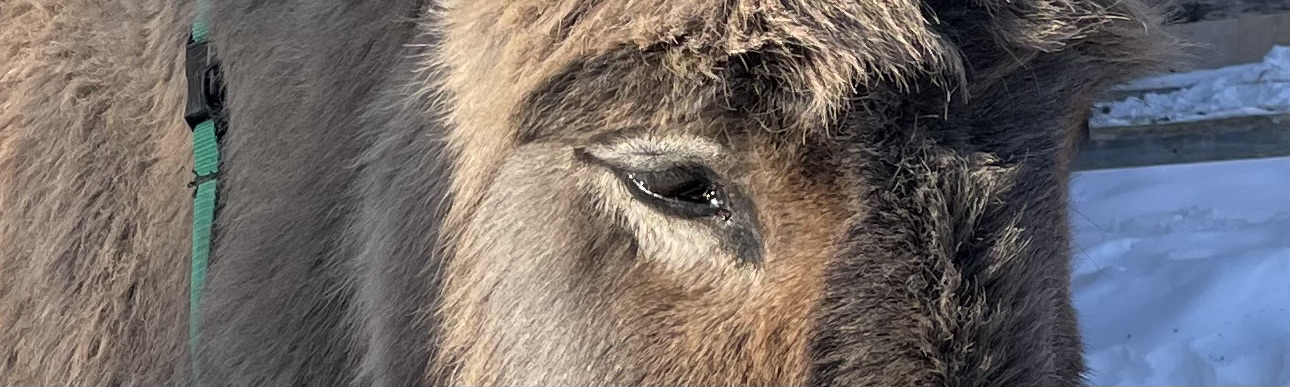
During our visit at the Primrose Donkey Sanctuary, a donkey named Zak walked all the way around the other donkeys to come and stand by me. I reached my hand over the fence to give him a good rub but he was too far away and would not come any closer. He seemed very sad!

A Primrose volunteer wandered over and said Zak had been pretty depressed lately because his partner had just died. I learned donkeys tend to pair bond and can show obvious signs of mourning. Zak evidently wanted our company, because he stayed with us even while maintaining his distance.

I’ve been thinking about Zak all week. Some farms acquire donkeys because they calm the other animals. Despite his grief, he gave me that sense of calm. The way he stood by us, stock still, quietly breathing in the cold winter air, seemingly listening to our conversation, giving us his full presence.

While the circus of global politics screams on, climate catastrophes rage, and staggering injustices occur around our planet, it has brought me strange comfort to think of Zak, a very present donkey living on a farm, missing his partner.

From his world to my world to yours, and all the worlds in-between …

Celia

PS ~ My mother wrote a book called “Dandelions Help” so thanks, Mum, for inspiring this month’s title.

Asking for Help

Dearest Readers,

Why is it so hard to ask for help?

When I was in high school, I learned how not asking for help can get you in trouble. I was directing a play in our little black box theatre and the previous group had left a cumbersome fireplace prop on the stage. Did I go and find someone to help me move it? Nope. I dragged the heavy object into the wings, knocking chunks of plaster off its corners and leaving scrape marks on the stage.

That afternoon, our teacher admonished the person ‘whodunit’ and dared her to come clean. I stayed silent but my conscience got the better of me and I confessed after class. The teacher praised me for telling the truth but then posed a perplexing question: Why didn’t you just ask for help?

Hm. That’s a tough one.

I guess nobody taught me how. I come from a family of DIYers and I’m not talking about renos. Lift it yourself. Carry it yourself. Figure it out by yourself. Manage it by yourself. Self-sufficiency is prized above all, to our detriment. Most of us still struggle to ask for help when we need it.

To ask for help is to admit weakness and weakness equals death. Too much of a stretch? I don’t think so.

Ironically, admitting I can’t do something actually brings me strength. One of life’s paradoxes. Thank goodness I’ve learned!

Just yesterday, I needed some help. My mental health was in the toilet and my best thinking told me to isolate and numb-out. Instead, I reached out. Twice.

Sent a voice message to a friend.

“Help. Not doing well.”

Just sharing that gave me the courage to call my boyfriend.

“I need life support.”

Vulnerable. Ugh. But he was able to love me into a better place. He couldn’t have done that if I hadn’t told on myself.

It sounds simplistic but if you need help, try asking for it. It makes a difference.

May Light from Every Possible Source brighten your darkness this holiday season.

Celia

Grr-attitude

Dearest Readers,

Last week was “American Thanksgiving” (as we call it here in Canada) and there was a lot of online content about gratitude. One post suggested that our brains are actually hardwired to focus on problems rather than solutions. What a relief! I thought it was just me.

Because I tend to look for what is wrong instead of what’s right, gratitude is something I need to practice. And I do. In order to change my negative outlook, I will often say the words “Thank you” when my brain is thinking, “F-you.”

Grumbling out loud is also something I like to do when I’m alone. “Grr,” when the snow is blowing back in my face after I’ve just it brushed off the car. “Grr,” when I’m trying to upload a photo and the file is too big. “Grr,” when I’m being asked for a two-step verification for the fourth time.

I am aware of my privilege as I write this. Some people don’t have cars, computers and bank accounts. My problems are definitely first class. Gratitude should be easy.

But “shoulding” on myself doesn’t help. What helps is understanding that “the human brain wraps around fear and problems like Velcro”. Being human is just plain hard and looking for the good takes guts and grit.

Going forward, I’ve decided to try a new practice. When I hear myself saying, “Grr,” I’m going to extend the word and say, “Grr-attitude.”

I’ll let you know how it goes.

On the path with you,

Celia

We are Complex Creatures

Dearest Readers,

I hope this letter finds you balancing the challenging times with the beauty of the moment. We’ve just had Thanksgiving here in Canada and despite the wackiness of the world these days, I’m feeling thankful to be a part of it.

Because of some big world news this week, I have been thinking a lot about human complexity and how we are not one thing.

For example:

An abusive husband can be tender with his children.

A skinny woman can think she is fat.

A peace activist can be cruel to his partner.

A feminist can pose nude for a men’s magazine.

A prevaricating authoritarian figure can negotiate a cease-fire.

We are not one thing!

Human behaviour is not black or white and people are contradictory and complicated. This is difficult to accept. It would be so much easier if we were all good or all bad, wouldn’t it?

I had a birthday recently and with it came a steady stream of compliments. “You are so compassionate, so kind and so generous!”

Yes, I can be those things. But I can also be mean-spirited, judgemental and arrogant. If the Apple Tech Support Agent and the Amazon Sales Rep had posted on my timeline you would have seen a more realistic picture of who I am.

We are not one thing.

Whenever I am struggling with jealousy, superiority or selfishness (some of my finest qualities), a friend of mine will say, “Welcome to the human race, Celia.”

A prevaricating authoritarian can negotiate a cease-fire. Welcome to the human race.

With love and humble pie,

Celia

Feel It

Dearest Readers,

How are you doing? I hope you’re going gently and experiencing some softness in these hard times.

You might be surprised to see another letter from me so soon. I’ve been averaging about two a year but I met an old friend in July who encouraged me to post more often. “Once a month!” he cheered as we said good-bye. (He’s a professional coach.)

So here I am again, a month later.

Lately, I’ve been listening to the audiobook version of “1984” by George Orwell (read by the brilliant actor Peter Capaldi) and finding its themes chillingly similar to what’s happening in our world today.

In 1948, Orwell imagined a future where the falsification of reality and acceptance of official lies were the cultural norm. Nearly eighty years later, here we are.

And yet …

“The Party had not been able to kill their human feelings. The Party had not been able to kill their humanity.”

These lines from the book strike deep. Somehow, in this age of fake news and corrupt leadership, we must continue to affirm our humanity through the simple act of feeling.

Feeling is difficult. Numbing out is much easier. We only have to stare at a screen. Or reach into our pockets for the phone. To identify a feeling I must reach into my Self.

I have a list of feelings at hand because I find it so challenging to name exactly what it is I’m feeling.

These days …

I feel horrified.

I feel angry.

I feel despair.

I feel powerless.

Naming the feeling seems to loosen the grip of anxiety. By saying, “I feel overwhelmed,” the stuck energy can move. “I feel numb,” can thaw the freeze state.

I recently witnessed a friend grieving openly in a support group. She kept apologizing for her tears, embarrassed that she was being such a “hot mess” in public.

But all of us in the group were then moved to share our own experience of grief. Her authenticity and vulnerablility strengthened and inspired us. We were uplifted.

When we share what’s really going on (in a safe space), we affirm our humanity.

And when we affirm our humanity, we participate in something greater than politics and war. We resist the forces of dehumanization.

Our feelings remind us: we are alive.

With you on the journey,

Celia