Worth It

Dearest Readers,

I hope you are continuing to find ways to make meaning in these fraught times. There is so much goodness to balance out the madness, it just needs to be sought!

The other day, I was presented with an opportunity to reflect on the concept of “worth” when I attended a talk by Hannah Moscovitch, a super-successful Canadian playwright and a top writer for television.

Hannah was honest and forthright about the highs and lows of writing for TV and made light of the “crazy difference in pay scale” between theatre and television. She joked, “When you’re a playwright, you’re like, ‘Thank you for this forty-five dollars’, and after writing for television for a while you’re like, ‘Wow, I can buy a ski chalet.’” Her candour was refreshing.

Naturally, Hannah’s success made me envious. For most of my young life, I was told I was going to be famous and it’s been an ongoing process to contend with the fact that I’m not.

After Hannah gave her talk, the part of me that longed for starry success needed some attention. I told my little fame-seeker that it was okay to want what Hannah had. It was okay to want to be the darling of critics, to have famous actors saying my words on the New York stage, to be an in-demand show-runner in the entertainment biz. It was okay to want all of that.

But did I really want it? Would I trade any of those things for the life I have now? What kind of “worth” does my life have?

Two things came to me. The first was the response of a dying man when I sang to him as he slipped away. “Thank you,” he said, “Thank you, thank you.” I will never forget, for as long as I live, the broken tenderness in his voice as he repeated his gratitude.

The second was the phone call I received from the same man’s brother, letting me know he had died. The brother was a life-long trucker: tough exterior, soft heart. As he broke the news, his voice quavered. He was torn apart but stoically holding it together. He thanked me for being his brother’s friend. It had meant something to them both.

How do we measure worth? I can’t buy a ski chalet but these two experiences make me feel like I’ve hit the jackpot.

May you discover and uncover what has worth in your life.

Celia

Impeccable Timing

Dearest Readers,

It feels strange to be sending you this letter after reading today’s terrifying headlines. I wrote the post a few days ago, before the attacks on Iran. Hopefully, what I’m writing about still has meaning despite the (ongoing) horrific events unfolding before us.

Last month, I wrote about donkeys and this month I’m going to write about owls.

A couple of weeks ago, a woman called me to inquire about spiritual direction. During our conversation, she told me her spirituality was deeply connected to nature. After she had shared a bit about what that meant for her, I told her that my spirituality, too, was connected to nature. The moment those words left my mouth, an owl flew across the yard.

Let me repeat that. At the precise moment I spoke the words, “My spirituality is connected to nature”, a large, grey owl, never before seen on our property, swooped directly across my line of vision.

“Oh my god!” I said (for what else does one say?). The vision of this majestic bird had filled me with wonder and awe.

I told the woman what had happened and we laughed at the seeming coincidence. Then the owl flew back the other way, showing me its expansive, patterned wings and soft, flat face. More awe and wonder.

Animal encounters like this one feel like spiritual events. Cosmic communion. They tell me there is something extraordinary happening behind the scenes. I like to call this Impeccable Timing.

Impeccable Timing is not really explainable. It happens when things converge in a meaningful or mystical way. Not everything that happens is Impeccable Timing—or maybe it is—but a man I met who was dive-bombed by an owl and had his scalp ripped open by the bird’s talons would probably say Not Impeccable Timing.

For me, that owl flying past my window, in that moment, as if my very words had breathed it into being, was Impeccable Timing. And IT has been keeping me going.

May we all continue to be awed by the wonder that can happen in our world.

With love and IT blessings,

Celia

Donkeys Help

Dearest Readers,

I hope you are finding ways to take care of yourselves, tend to your needs and have fun in these fraught and uncertain times. When life is so precarious it feels more important than ever to do these simple things.

As an example, I recently paid a visit with some friends to the Primrose Donkey Sanctuary. I have always loved donkeys. When I was a child, I had a picture book called “Donkey, Donkey” about a donkey who doesn’t like his ears. I didn’t like mine either so I understood him.

In 2013, when I was on a month-long retreat in Ireland, I made friends with a donkey who lived in a field along my walking route. Once we established a connection, he would come to the fence to say hello and get a rub whenever I passed by.

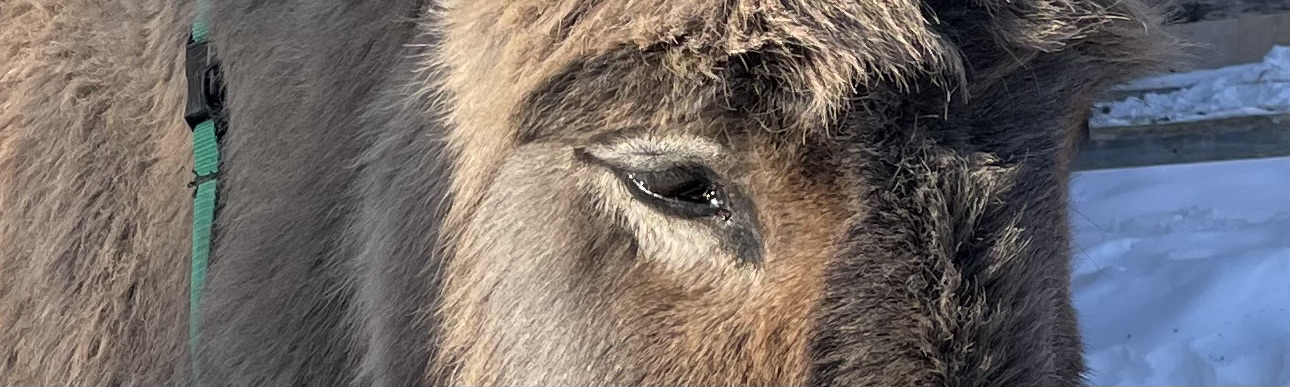
During our visit at the Primrose Donkey Sanctuary, a donkey named Zak walked all the way around the other donkeys to come and stand by me. I reached my hand over the fence to give him a good rub but he was too far away and would not come any closer. He seemed very sad!

A Primrose volunteer wandered over and said Zak had been pretty depressed lately because his partner had just died. I learned donkeys tend to pair bond and can show obvious signs of mourning. Zak evidently wanted our company, because he stayed with us even while maintaining his distance.

I’ve been thinking about Zak all week. Some farms acquire donkeys because they calm the other animals. Despite his grief, he gave me that sense of calm. The way he stood by us, stock still, quietly breathing in the cold winter air, seemingly listening to our conversation, giving us his full presence.

While the circus of global politics screams on, climate catastrophes rage, and staggering injustices occur around our planet, it has brought me strange comfort to think of Zak, a very present donkey living on a farm, missing his partner.

From his world to my world to yours, and all the worlds in-between …

Celia

PS ~ My mother wrote a book called “Dandelions Help” so thanks, Mum, for inspiring this month’s title.

We are Complex Creatures

Dearest Readers,

I hope this letter finds you balancing the challenging times with the beauty of the moment. We’ve just had Thanksgiving here in Canada and despite the wackiness of the world these days, I’m feeling thankful to be a part of it.

Because of some big world news this week, I have been thinking a lot about human complexity and how we are not one thing.

For example:

An abusive husband can be tender with his children.

A skinny woman can think she is fat.

A peace activist can be cruel to his partner.

A feminist can pose nude for a men’s magazine.

A prevaricating authoritarian figure can negotiate a cease-fire.

We are not one thing!

Human behaviour is not black or white and people are contradictory and complicated. This is difficult to accept. It would be so much easier if we were all good or all bad, wouldn’t it?

I had a birthday recently and with it came a steady stream of compliments. “You are so compassionate, so kind and so generous!”

Yes, I can be those things. But I can also be mean-spirited, judgemental and arrogant. If the Apple Tech Support Agent and the Amazon Sales Rep had posted on my timeline you would have seen a more realistic picture of who I am.

We are not one thing.

Whenever I am struggling with jealousy, superiority or selfishness (some of my finest qualities), a friend of mine will say, “Welcome to the human race, Celia.”

A prevaricating authoritarian can negotiate a cease-fire. Welcome to the human race.

With love and humble pie,

Celia

Feel It

Dearest Readers,

How are you doing? I hope you’re going gently and experiencing some softness in these hard times.

You might be surprised to see another letter from me so soon. I’ve been averaging about two a year but I met an old friend in July who encouraged me to post more often. “Once a month!” he cheered as we said good-bye. (He’s a professional coach.)

So here I am again, a month later.

Lately, I’ve been listening to the audiobook version of “1984” by George Orwell (read by the brilliant actor Peter Capaldi) and finding its themes chillingly similar to what’s happening in our world today.

In 1948, Orwell imagined a future where the falsification of reality and acceptance of official lies were the cultural norm. Nearly eighty years later, here we are.

And yet …

“The Party had not been able to kill their human feelings. The Party had not been able to kill their humanity.”

These lines from the book strike deep. Somehow, in this age of fake news and corrupt leadership, we must continue to affirm our humanity through the simple act of feeling.

Feeling is difficult. Numbing out is much easier. We only have to stare at a screen. Or reach into our pockets for the phone. To identify a feeling I must reach into my Self.

I have a list of feelings at hand because I find it so challenging to name exactly what it is I’m feeling.

These days …

I feel horrified.

I feel angry.

I feel despair.

I feel powerless.

Naming the feeling seems to loosen the grip of anxiety. By saying, “I feel overwhelmed,” the stuck energy can move. “I feel numb,” can thaw the freeze state.

I recently witnessed a friend grieving openly in a support group. She kept apologizing for her tears, embarrassed that she was being such a “hot mess” in public.

But all of us in the group were then moved to share our own experience of grief. Her authenticity and vulnerablility strengthened and inspired us. We were uplifted.

When we share what’s really going on (in a safe space), we affirm our humanity.

And when we affirm our humanity, we participate in something greater than politics and war. We resist the forces of dehumanization.

Our feelings remind us: we are alive.

With you on the journey,

Celia

Fixing a Hole

Dearest Readers,

Summer has just past its peak in this little corner of the world. It has been much too dry of late but we have been spared the wildfires (so far). The forest outside my window is a palette of greens. Birds twit. Bees buzz. Squirrels and chipmunks scamper. It’s idyllic.

Then I read the news headlines and I feel heartbroken and helpless. Anger and sadness ebb and flow. I listen for the voices who are calling for justice and peace. I look for the activists who persevere. I watch Nature rebuild. We go on.

Recently, in a contemplative moment, a memory returned to me: when I was three or four, I climbed down into a hole in our backyard that had been dug for a fence post. The hole had been covered over with a board and we’d been told not to go near it but what did I do? I pulled the board away and shimmied down into the hole, wedging myself in so tightly that the fire department had to come and dig me out.

The event was traumatic for my parents. For me, it was the opposite. I remember only being in the hole with my face gently pressing on the wall of cold, damp clay, typical of Yukon soil. There was no fear. I felt happy and safe.

What possessed me to defy the parental no-no and subject myself to an emergency rescue? Did I want to see what would happen? Was I trying to get away from a stressful home life? Did I wish to disappear from the world? All of the above?

I’m curious about that little girl who found solace in being trapped in the earth, breathing in the mineralic smell of the clay. When the memory resurfaced, I wondered if she might be trying to tell me something today.

Dig in.

Go deep.

Breathe with the Earth.

With the world such as it is, these simple directives feel crucial. In the face of despair, I commit to maintaining the spiritual practices and soul work that bring the change I want to see in the world.

Does your younger self have wisdom for you, too?

On the path,

Celia

Stay the Course

Dearest Readers,

As I write this letter, the sun is shining brightly on the snow in the park across the street and a big elm is casting deep blue shadows on the shimmering white. The sky is a much paler blue, a powder blue, like a young man’s prom tux in the disco era. It’s a gorgeous March day.

With the world the way it is right now, turning my focus to steadfast things like sun, snow, wind and skies, is a way to stay grounded. The sun shines faithfully, the snow falls predictably, the wind blows steadily, the sky is ever-present. Nature stays the course.

These days, “staying the course” is a good practice. It’s straightforward, constructive and do-able. Especially when the fear kicks in. “Yikes! Panic! Chaos! Uncertainty! War! Terror! Dictators taking over the world!”

Stay the course. Stay. The. Course.

A quick search tells me the phrase is likely nautical in origin, a captain’s instruction to the helmsman in difficult conditions. This makes sense. “Stay the course, Sailor!” is much easier to say than, “Maintain a consistent, unaltering path while navigating these difficult conditions, Sailor!”

Current conditions are difficult and the desire to alter the present-day path is huge. How to find the ground when the rug has been pulled out from underfoot?

Stay the course.

Suit up. Show up. Do your best. Let go of the rest.

In 2015, when I was living in England and providing spiritual care for the residents in a nursing home, I was amazed by how often “The War” would come up during conversations. These men and women had all lived through WWII, and more than seven decades later its impact was still being felt, remembered, and talked about.

What struck me most was how these now-elderly people had kept going during the most harrowing of times. They described getting on with their daily lives while being bombed, while their loved ones disappeared, while the war dragged on. The cooking had to be done, someone had to go to work. Kids went to school. Young people went to the cinema. Dancing happened every night! They stayed the course.

This is what I think about when it all seems utterly hopeless. Do your daily life. Brush your teeth. Go to work. Do the things that need doing. And try to have some fun!

Stay the course. It’s a good practice.

With love and blessings as you consistently and unalteringly navigate the challenges in your own lives,

Celia

Only Create

Dearest Readers,

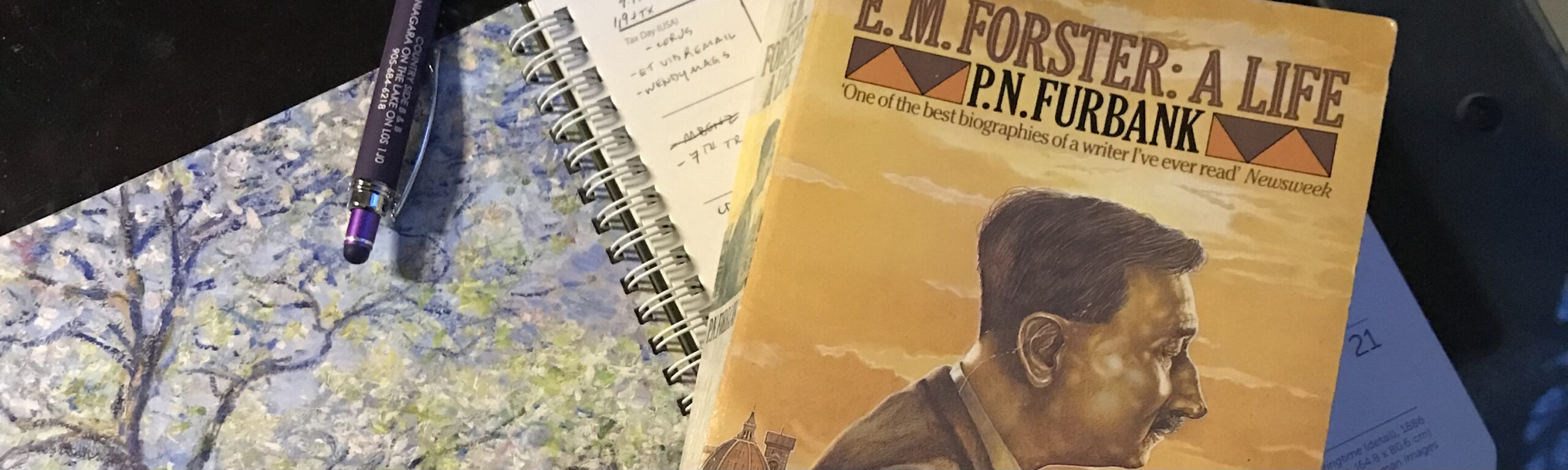
“Only create” is a loving rip-off of E.M. Forster’s famous quote, “Only connect.”

I’ve been devouring all things Forster lately, re-reading his well-known novels (Where Angels Fear to Tread, Room with a View, Howard’s End) and discovering his lesser-known ones (The Longest Journey); exploring his science-fiction and fantasy short stories (who knew?) and re-watching film adaptations (A Passage to India).

Forster was so, so brilliant. Much of his work is about rejecting convention in order to live passionately. His characters alternately ignore and drink in life’s beauty. “Only connect” was his command for living. Drop pretense. Wake up to your deepest self.

While I’ve used Forster’s quote “only connect” as a descriptor for my work in many a grant-proposal, I’m changing it to “only create” because creating has been helping me to feel good about myself lately and who doesn’t need a self-esteem boost in these times of posting and posing and comparing/despairing?

Creation is the antidote.

In a recent blog about “Peace as an Everyday Practice”, I quoted a friend who’d said, “Peace is not the opposite of war, creation is.”

Because creating is life-affirming and life-giving.

I often avoid being creative because the inner critic is telling me, “You suck, don’t bother.”

Or if I do manage to muster the courage to create something new, fear will jump in to stop me. “It’s not good enough.”

I want (and need) the self-confidence that comes when I let creativity reign therefore ignoring the voices of dissent and walking through my fear has become an essential practice.

Last year, I wanted to create a painting of a photo of me sleeping curled up with my blankie at age three. I was terrified because I’d never really painted a portrait like that before and didn’t think I would succeed. But I wanted to try.

I started the painting and struggled. I procrastinated. When I did work on it I’d end up in the worst mood. It made me so angry!

Perfectionism, the creativity killer.

I realized needed help and signed up for a painting class. I practiced and got better. By letting go of the need to “get it right” and allowing the paint to teach me, I finished the painting and submitted it to a juried art show. Much to my delight, the painting was accepted.

The painting will soon hang in a gallery with the work of other artists and that is a big deal for me. But more importantly, I feel good about myself. And if you live with low self-esteem like I do, that is the bigger deal.

If you are one of those people who says, “I don’t have a creative bone in my body” then listen closely: that is a lie you have been telling yourself.

Because I’ve witnessed you making a collage and discovering you have a knack for it. I’ve seen you do improv and find out you’re a natural clown. I’ve noticed the way you dance. I’ve watched you plant your garden. Cook a meal. Write a letter.

Being creative doesn’t mean you know how to draw! Being creative means you let the Creative Force that is animating our bodies and fuelling our imaginations create something, anything, through you.

So drown out the inner critic and persevere. Allow creativity to come through. Generate some good feelings for and about yourself.

Only create!

With love and blessings,

Celia

We must be willing to let go of the life we have planned, so as to have the life that is waiting for us.

~ E.M. Forster

What the H?

Dearest Readers,

The other day I was speaking about self-care with a resident in the Long-Term Care home where I work and in the middle of our discussion I said, “Most of us need to have a self-care plan at the ready before we cross the line into–”

“Hell,” he said, finishing my sentence for me.

That’s not what I was going to say but I laughed out loud because he nailed it.

Yesterday, I started to watch a video on YouTube about a woman who “Met God and Saw the Future”. She’d come back to life after having a Near Death Experience (NDE) with a new understanding that the afterlife is actually “Home” and life on Earth is, in fact, “Hell.”

Then, last evening, I had a meaningful conversation with woman who lives with pretty intense mental health issues. She talked about her struggles and her suidical ideation, summing it all up by saying, “Life is hell.”

Okay, three mentions of “hell” in as many days? I thought I’d better write about it.

I’ve never subscribed to the idea of Hell as a place we go after we die. But this idea that Life is Hell? Certainly in my darkest hours I have felt it to be true.

People who have NDEs often experience a state of “overwhelming, unconditional love” (as the woman in the video did) and so it makes sense that life here, with its pain and suffering and confusion, would seem like Hell in comparison.

Yet life on Earth includes this phenomenon called Beauty and despite the hell states of war, tragedy, depression and illness, Beauty is everywhere.

And the one generator of Beauty that we all seem to agree on?

Nature. Nature gives us so much Beauty.

As I was driving home the other day, a luminescent split in the darkening sky was spilling forth the brightest light imaginable from a towering wall of black clouds.

Despite the fact that this heavenly hernia was nearly blinding me and black spots in my vision were making it difficult to see the road, I kept turning my eyes back toward it.

It seemed an apt metaphor for how human beings seek Beauty. We want to look at it. We want it to blind us. We want to be dazzled and blown away by it and reassured that it exists, that we can see it, that it is there for us.

And it is. Beauty is everywhere. This is an undeniable, indisputable truth.

With three mentions of Hell and two more of “the End Times” (that’s another Letter), it’s fair to say that we are living in an extremely challenging time in history. For those who are in the trenches of war (actual and political), it’s truly Hell. For those of us feeling powerless to make a difference in these situations and in our own lives, it’s hell.

And yet Nature continues to abide and bedazzle us all, continually striking us with this mysterious paradox: Life is Hell and Life is unfathomable Beauty.

Somehow we go on, knowing both.

Blessings to you on your Healing Journey,

Celia

Peace as an Everyday Practice

Dearest Readers,

This blog entry is actually a keynote speech I gave recently called “Peace as an Everyday Practice” for the YMCA Peace Medal Awards.

It’s long so if you’d rather watch me deliver it, click here for the YouTube version. (20 minutes)

If you have a bit of time, read on.

The YMCA Peace Medal Award is an honour given to non-professional peacemakers who are creating change in their communities through selfless action.

In a world where we are posting on social media what we made for dinner and pictures of our cats playing with tinfoil, selfless action is currently a pretty radical act.

And selfless action toward making Peace is even more exceptional because we are living in a time of war.

Not just the wars in Ukraine and Israel-Palestine but the climate wars, the media wars, the culture wars, the political wars, the race wars, the gender wars … there is so much division and strife in our world.

And it boggles the mind because it’s 2023! We know stuff. We’ve learned a lot of stuff. We’re supposed to be evolved.

We possess the scientific understanding that despite our differences on the outside, humans are 99.9% genetically similar to one another.

Yet we continue to focus on the 0.1% that is different and we kill each other over it.

Most of us know John Lennon sang “Give Peace a Chance” and asked us to, “Imagine all the people living life in peace,” but did you know that he also challenged world leaders to: Declare Peace?

“Just the same way we declare war,” he said. “That is how we will have peace … we just need to declare it.”

It’s so simple. Isn’t it? Declare Peace.

Imagine all the leaders just saying “We Declare Peace”. How different our world would be?

Peace has many angles. It’s complex. It’s not one thing.

I read a quote that said “Peace holds many truths” and that sounded right to me.

In order to talk about Peace as an Everyday Practice, I went looking for examples of peace, where the word or the concept has shown up in my life.

And I thought of the concept of the passing of the peace in Christian churches. This is when everyone either shakes hands or makes a sign of peace to others.

Whenever I attended a service I would look forward to this lovely way of connecting, passing peace to each other.

I wish we could do that on the street. You know? Instead of casting down our eyes or ignoring the fact that we’re all in a grocery store together, we could pass the peace to each other.

And I thought about the chant I offer when I teach yoga, OM Shanti OM Peace, which we do to generate peace in the body and peace in the world.

I wish we could all take the time to chant peace in the office, or at the bank, when we’re waiting in line for the teller.

Om Peace Peace Peace. That’d get me to the front of the line. I think. Maybe not.

I thought about my Indigenous friend who told me after her partner and a number of her family members had died that she realized that she doesn’t own all her dead loved ones and that she wasn’t afraid to die herself.

That struck me as perhaps the greatest peace there is. Detachment from loss and not being afraid to die.

I thought about my wise and humble friend who once said that when it comes to making peace, there was not a lot he could do up here, and he kind of swirled his hands around up by his head, indicating where systems live.

“But,” he said, bringing his hands toward his belly, “there’s a lot I can do down here,” and he swirled his hands around in front of him, to indicate the grassroots level, where he works.

And this is where Peace as an Everyday Practice comes in for me.

Because with the world the way it is, I find myself wanting to force the people in power to Declare Peace. And I can’t. I don’t have any power “up here.”

But I can practice Peace “down here” and I can practice peace in my own life.

And calling it a Practice is very deliberate because, despite being the keynote speaker at the YMCA Peace Medal Awards I have not, in fact, achieved peace in my own life.

Surprise!

It’s true though, because like so many humans on the planet right now, I live with a core of not-good-enoughness, the foundation of which comes, and I know I’m not alone here, from a complex web of developmental and sexual trauma, intergenerational alcoholism and addiction and mental health issues.

And I live with anxiety and depression. And I wrestle with the burden of colonial shame and feel acutely the pressing accountability and responsibility of white privilege, and I have been affected, as we all have, by the oppressive legacy of patriarchal systems, which continue to encourage all of us to look outside of ourselves for approval and seek satisfaction in material gains.

The truth is, it would be dishonest of me to preach the Gospel of Peace without telling you that my reality consists of practicing achieving peace on a daily basis because I live with a perpetually unpeaceful mind.

Maybe that’s why I got asked to speak about peace. Because I work so darn hard at practicing it.

I mean, I gotta. Because if I’m not meditating and engaging in spiritual practices and eating right and doing yoga and walking and going to recovery groups and therapy and reaching out to like-minded others and engaging in social justice activities, this brain will have no peace.

This brain will try and kill me.

It will say (and it does), “You are not good enough.”

And it will say (and it does), “What’s the point in doing anything?”

That’s the internal war.

That’s the war of self-loathing and apathy.

And I think that’s what is radiating outward from so many humans to generate the wider wars.

Do you think if we all actually loved and appreciated and valued ourselves as individuals we’d be fighting over anything?

I don’t think so.

So Peace as an Everyday Practice means checking in with ourselves and each other. Not checking our numbers, our socials, our followers, our likes.

Because we are not these things. But when we identify ourselves with our numbers, our socials, our followers and our likes, well, we feel bad.

Because it’s never enough. There’s never enough in the bank account and there are never enough likes.

So practicing peace every day becomes the practice of noticing what makes me feel bad about myself and stopping doing it.

It becomes the practice of cultivating inner enoughness, which is to say, inner acceptance and, therefore, inner peace.

Last year, I published a book. It’s a memoir called “O My God: An Un-Becoming Journey” and it’s about how I felt called to become a monk but realized that everything I thought I had to become I Already Am.

And I would like to sell this book to a lot of people. I would really like it to become a bestseller.

But when I focus on the pressure of selling lots of copies, and when I am obsessing about the number of books I haven’t sold yet and how many people didn’t “heart” my last Insta post, I have no peace.

I am at war with myself.

When I focus on the fact a Gentle Reader sent me an email to tell me that she had lost her spiritual connection years ago and the book helped her to get it back, or that another Gentle Reader told me that the book made her feel human because it validated her own fears and doubts, I find myself feeling something that can only be described as peace.

Because this change in focus begets gratitude for what I already have. And humility for who I already am.

This is a feeling that can’t be measured by numbers. It’s the feeling of being enough.

It’s pretty easy to have peace when everything goes my way. But what about when things don’t go my way? Peace goes out the window. Along with the laptop when the spinning ball of death appears.

No, I’ve never chucked an expensive piece of computer equipment out the window but I’ve felt like it!

Having a sense of humour when mistakes happen or chaos reigns or even just when the weather isn’t doing what I want it to do … these are all great opportunities to practice peace.

Find the humour. Not easy. Practice!

I recently had to wear an air cast for 6 weeks after falling and fracturing a bone in my foot. After processing the depression and the anger that came through grieving (aka bawling my eyes out), I was able to find the laughter. “What happened?” people asked me. “I guess needed a break,” I told them.

But finding things funny when we’re not in control takes courage.

And most human beings want to be in control. Learning to be peaceful when things are out of control or uncertain or not working for us can be very difficult. It’s a lot easier to get annoyed and take it out on the driver in front of us. Or the cashier.

But this is where the practice of letting go and trusting comes in.

Okay, what do I trust when the ship hits the sand? Do I trust God? Do I trust the Universe? Do I trust that everything is going to be okay?

We can do ALL that. But the ship is still going to hit the sand.

It’s much more practical to trust that the ship is going to hit the sand AND I’m going to be okay.

So that’s what I do. I practice trusting that I’m okay even if things aren’t okay.

But I’m human so I still try to maintain the illusion of control. And one of the ways I do that is by judging others.

It’s an ugly thing to admit at a Peace award ceremony but after years of trauma work, I understand that judging others is the trauma-brain trying to keep me safe.

But it’s really toxic. “He’s not getting this right, she’s not getting that right, he’s not doing this enough, she’s doing that too much.”

No one is following the script I’ve written for them! And I’m very unhappy about it. I’m quite miserable.

And I definitely don’t have peace.

But life is radically uncertain and judging creates the illusion of certainty. Judging is me feeling unsafe but trying to make life predictable so I can get through the day.

We are so vulnerable.

Control is safe. And underneath all that control and all that judgment is just a scared little kid who wants to be loved. Who wants to belong.

So practicing peace is really about cultivating this kind of conscious self-awareness of the mind.

When I get to know my mind, when I question my thinking, I start to SEE the judgment rather than buying into what it’s telling me.

And when I can see it, I can practice letting go of it. I can practice looking at what people are doing right and that they, like me, are already enough. Just as they are.

And the peace comes.

So, yeah, I’m sorry to break it to you but Peace is work. And Peace is a choice.

Peace in the world requires that we make a decision to participate in protests and petitions and speeches and marches and organization. It requires that we declare it and then choose to take action and more action.

And Peace in ourselves also requires work. And it’s also a choice.

It requires that we become willing to change our minds, to surrender our fixed ideas, to let go of the need to be right. To let go of the illusion of control.

These are all choices.

Peace happens when I have the courage to say, “I’m wrong”, “I don’t know”, or “I made a mistake” or “I’m sorry, that was coming from a fear place in me.”

Or, hey, keep it simple, and just say what the kids are saying these days, “My bad.”

Another way to practice peace in our daily lives is to engage in creativity. A good friend recently said to me, “Peace is not the opposite of war, creation is.”

Creation.

So, I’m a creative person. I write, I paint, I draw, I dance. I was a theatre artist and filmmaker. I’ve been given lots of creative gifts.

But when I avoid being creative because the negativity is in the driver’s seat saying, “You suck, don’t bother,” I’m not at peace.

Or when I do manage to muster the courage to do something creative and the fear jumps in and says, “It’s not good enough,” then no peace.

This is when I need to choose to become my own best advocate.

So I put my hand on my heart and say to myself, “Sweetie. Aww. It doesn’t have to be perfect. You’re trying. Good for you. Creating is fun! Just have fun, that’s all that matters.”

And I immediately start to feel okay. I start to feel like I’m enough. I start to feel peace.

This kind of self-encouragement is a foreign concept to most of us. But I’ve found it to be a vital practice for building self-esteem and healing those domineering negative voices.

Becoming my own best friend is peace-building because when I’m on my side I’m way more likely to be on your side.

When I’ve said, “It’s no longer okay to be my own worst enemy,” chances are, you are going to look less and less like my own worst enemy, too.

And we can all create! We ALL have this Creative Life Force Energy flowing through us, animating our bodies, fuelling our imaginations.

With this dynamic energetic part of us, we can create community, art, technology.

We can create friendships, healing circles, and reconciliation practices.

We can create more inclusive attitudes, more open minds, and more open hearts.

Creation is our Essence. It’s the stuff we’re made of. And when we tap into that Creative Life Force Energy, we are making Peace.

We’re making the peace we all long for. The peace we’re waiting for others to declare.

Let’s declare it for ourselves by practicing it ourselves.

Let’s root out the self-hatred so we don’t project it on each other.

Let’s root out the judgment so that instead of pointing that finger at someone else we can see OH! there are three fingers pointing back me!

Let’s root out this deep down inside of us core of unworthiness so we don’t impose our not-enoughness on other people.

Peace starts here. We know this.

But what we may not know is that every single day we can practice choosing to like ourselves a little bit more, and to affirm our own basic goodness no matter what our mistakes and transgressions might be.

We can create anything from this power living inside of us, this Dynamic Force of Energetic Awesomeness that is the Source and Generator of justice, love, forgiveness, mercy, humility, and gratitude. All the good stuff.

We can do this. The Peace Medal recipients are evidence of our human capacity for selfless action.

So let’s all Declare Peace in the world by declaring peace in our own lives.

Every day, try saying it: I declare Peace with myself.

I declare Peace with myself.

Say it now, out loud, as you read it:

I declare Peace with myself.

From the fires of love,

Celia